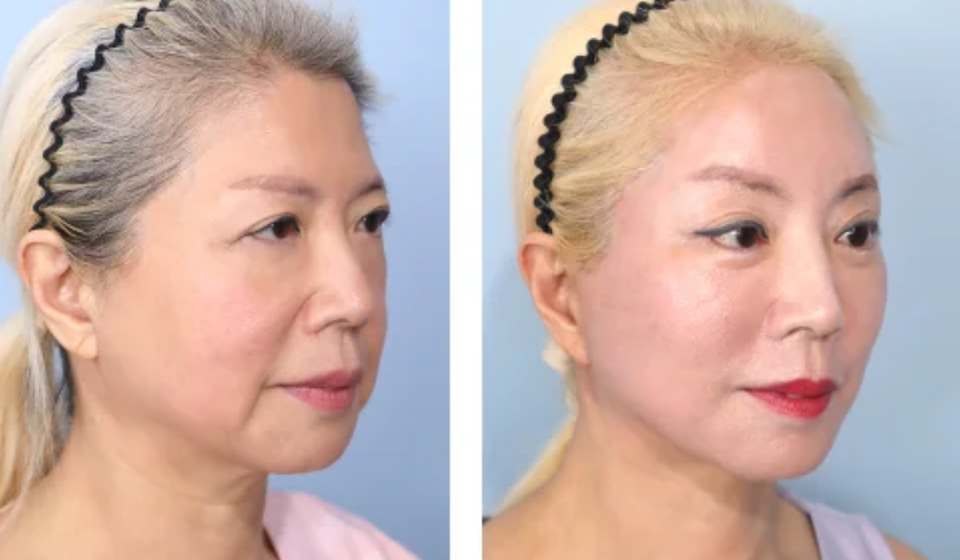

◆ What Is a Facelift?
A facelift (Face Lift) is a surgical procedure that restores descended facial structures back to their original anatomical position.
Aging affects not only the skin but also deeper layers such as fat, muscles, SMAS (Superficial Musculoaponeurotic System), periosteum, and even the neck structures.
Therefore, a facelift is not a simple skin‑pulling procedure.
It is a high‑level anatomical surgery that reorganizes the deeper facial structures.
A facelift elevates the downward‑shifted facial components and fundamentally improves:
- Sagging cheeks
- Deep nasolabial folds
- Marionette lines
- Blunted jawline
- Loose neck skin
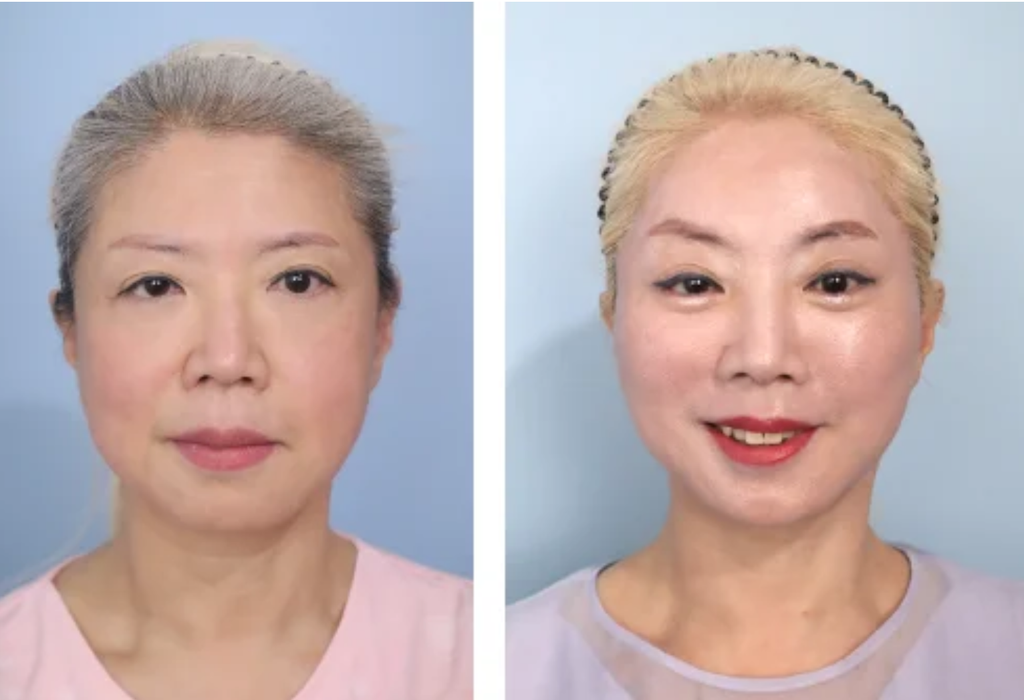
◆ Why Does the Face Sag?
Aging is not just thinning of the skin.
Multiple structural changes occur simultaneously:
Skin Layer Changes
- Decreased collagen
- Reduced elasticity
- Thinning of the skin
Fat Layer Changes
- Fat descends downward
- Volume loss
- Midface hollowing
Muscle Layer Changes
- Reduced tone of facial muscles
- Changes in muscle position
SMAS (Fascial Layer) Changes
- SMAS descends
- Face appears longer
Deep Plane / Periosteal Changes
- Deep Plane structures shift downward
- Nasolabial & marionette folds deepen
Neck Structure Changes
- Platysma muscle separation
- Formation of “turkey neck”
These changes cannot be corrected by pulling the skin alone.
This is why facelift surgery focuses on lifting the deeper structures beneath the skin.
◆ The Core of a Facelift: Lifting the Facial Structure, Not the Skin
A true facelift does not simply tighten the skin.
It lifts the deeper layers — SMAS and even the Deep Plane (sub‑periosteal layer).
Why must the deeper structure be lifted?
- Nasolabial folds form because the SMAS and Deep Plane structures descend.
- Cheek sagging occurs because muscles and fascia shift downward.
- Jawline collapse happens due to platysma and Deep Plane laxity.
If only the skin is tightened:
✔ Short‑lasting results
✔ Unnatural expressions
✔ Sagging returns quickly
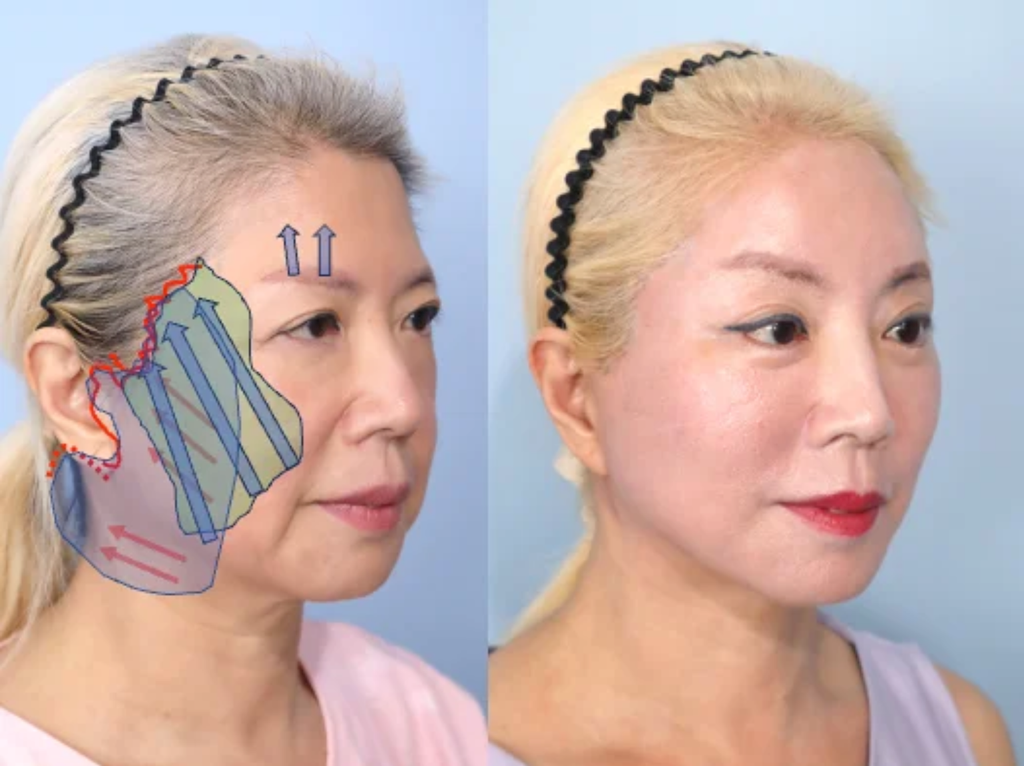
◆ Kidari Plastic Surgery’s Advantage: SMAS + Deep Plane Dissection
The quality of a facelift depends on how deep the surgeon dissects.
Most clinics perform:
✔ Skin → SMAS dissection only
However, Kidari Plastic Surgery performs:
✔ SMAS dissection
✔ Deep Plane (sub‑periosteal) dissection
What is Deep Plane dissection?
The Deep Plane is the deepest facial layer beneath the periosteum.
Dissecting this layer allows the muscles, fat, and SMAS to move as one unified block.
Benefits of Deep Plane Facelift
- Significantly longer longevity
- Skin-only lift: 6 months–1 year
- SMAS lift: 3–7 years
- Deep Plane lift: 10+ years
- Superior improvement of nasolabial & marionette folds
- Natural restoration of midface volume
- More natural facial expressions
- Smooth jawline & neck contour
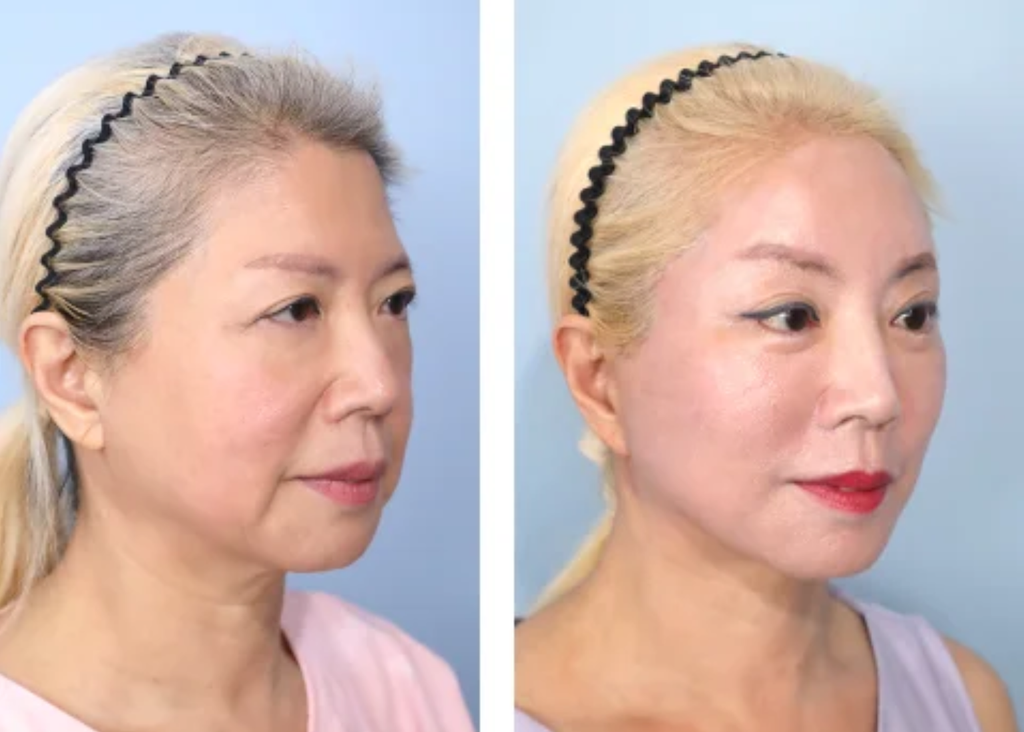
◆ Types of Facelift Surgery
1. Full Facelift
For patients with aging across the entire face.
Incision areas:
- In front of the ear
- Earlobe
- Behind the ear
- Extending to the occipital hairline
Effects:
- SMAS + Deep Plane dissection
- Nasolabial & marionette fold improvement
- Cheek lifting
- Jawline restoration
- Neck wrinkle improvement
- Longest-lasting results
2. Short Scar Facelift
Shorter incision and faster recovery.
Incision:
- Primarily in front of the ear
Effects:
- Vertical SMAS lift
- Cheek & nasolabial improvement
- 70–80% of full facelift effect
- Minimal scarring
3. Ponytail Lift (Updated from Mini Facelift / Temporal Lift)
A Ponytail Lift is performed through a small 1–2 cm incision in the temple area, lifting the midface and upper cheek in a natural, upward vector — similar to the effect of tying hair in a high ponytail.
Effects:
- Improvement of nasolabial & marionette folds
- Correction of cheekbone sagging
- Fast recovery
- Popular among younger patients seeking a subtle, natural lift
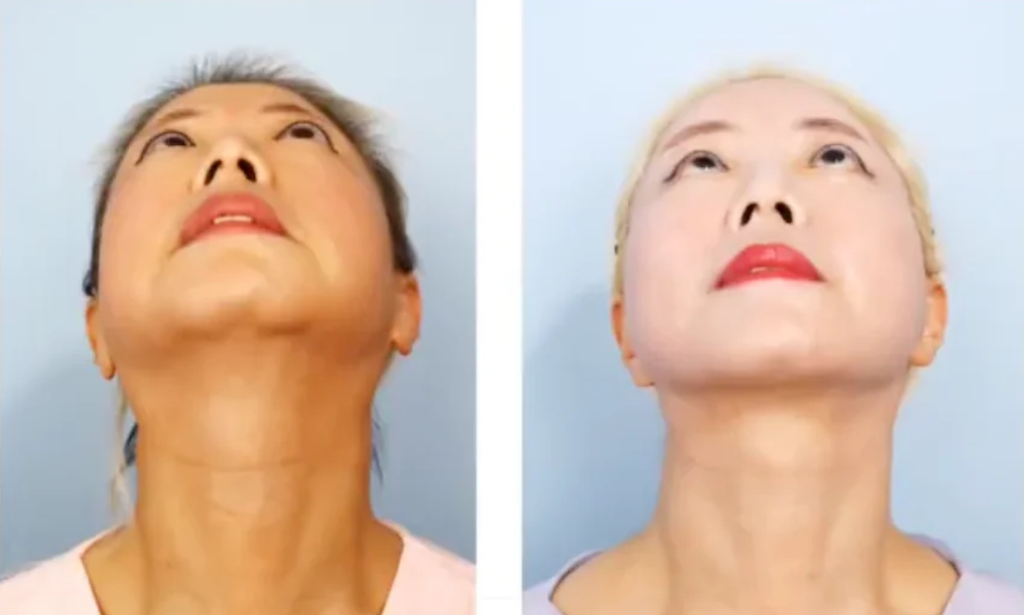
◆ “Corset Neck Lift” for Neck Sagging
With age, the platysma muscle separates, creating a “turkey neck.”
The corset neck lift tightens the platysma centrally to redefine the neck contour.
Effects:
- Turkey neck improvement
- Neck wrinkle reduction
- Jawline restoration
- Maximized results when combined with full facelift
◆ Midface Lift for Central Facial Rejuvenation
Youthfulness is determined by the central face.
A midface lift elevates the structures that create marionette lines, nasolabial folds, and cheek sagging.
Effects:
- Marionette line improvement
- Nasolabial fold reduction
- Midface volume restoration
- V‑line enhancement
◆ Lower Eyelid Surgery + Aegyosal for Under‑Eye Aging
A facelift alone cannot correct under‑eye aging.
Effects:
- Under‑eye fat repositioning
- Dark circle improvement
- Under‑eye wrinkle reduction
- Aegyosal volume enhancement
◆ Sub‑Brow Lift for Forehead & Eye Rejuvenation
Performed through an incision beneath the eyebrow to lift the forehead muscles.
Effects:
- Larger, more open eyes
- Clearer double eyelid line
- Reduced crow’s feet
- Dome-shaped, youthful forehead
◆ Facelift Procedure — Step-by-Step
Pre‑operative Planning
- Facial aging analysis
- Determining aging direction
- Selecting necessary combination procedures
- Designing incision lines
- Planning Deep Plane dissection
During Surgery
- Incision
- SMAS + Deep Plane dissection
- Repositioning muscles & fat
- Fixation with Endotine
- Neck lift (if needed)
- Skin closure
Post‑operative Recovery
- Bruising & swelling: 1–2 weeks
- Stitch removal: ~7 days
- Natural expression recovery: 2–4 weeks
- Final results: 3–6 months
◆ Facelift Risks & Precautions
Facelift is a high‑level anatomical surgery and must be performed by a specialist with deep structural knowledge.
Possible risks:
- Bruising & swelling
- Temporary numbness
- Incision scars
- Asymmetry
- Over‑tightening
Kidari Plastic Surgery minimizes unnatural expressions and over‑tightening through Deep Plane techniques.
◆ Facelift FAQ
Q. How long does the result last?
Deep Plane facelifts last 10+ years.
Q. Are the scars noticeable?
Incisions are placed around the ear and temple, where they are minimally visible.
Q. How is it different from thread lifting?
Thread lifting is temporary and does not lift the SMAS.
A facelift elevates the SMAS and Deep Plane structures.
Q. What is the recovery time?
Return to daily life: 1–2 weeks
Final results: 3–6 months
Q. Who needs a facelift?
Those with nasolabial folds, marionette lines, cheek sagging, jawline collapse, or neck sagging.
◆ Kidari Plastic Surgery’s Facelift Is Defined by “Depth”
A facelift is not a skin-tightening procedure —
it is an anatomical surgery that reconstructs the facial structure.
Kidari Plastic Surgery provides:
✔ SMAS + Deep Plane dissection
✔ Midface volume restoration
✔ Natural facial expressions
✔ Long‑lasting lifting results
A facelift that satisfies all four essential elements.
🔗 Kidari Plastic Surgery Official Website
🎥 Kidari Plastic Surgery YouTube Channel
https://youtube.com/channel/UC8n-YGd3wJaahGeESfi8ldA
Kidari Plastic Surgery — Official Notice
✔ This content provides general medical information for educational purposes.
Accurate diagnosis and appropriate treatment plans must always be determined through consultation with a qualified specialist.
✔ All surgical and non‑surgical procedures may involve potential side effects,
including swelling, bruising, bleeding, infection, scarring, asymmetry,
and the possibility of revision surgery, depending on the individual.
✔ This content reflects the personal treatment experience (review) of a specific individual,
and results may vary depending on each patient’s unique condition.